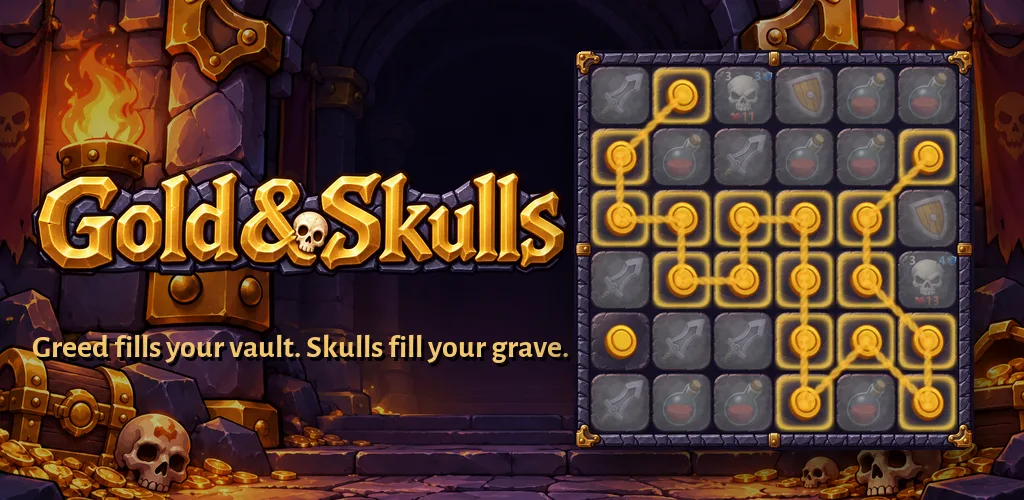
Around 2011 I played a small chain-matching dungeon game on my phone. It has since been discontinued and is not available anywhere anymore, and for fifteen years I kept wanting it back, with a list of my own ideas bolted on. So I built it. Gold & Skulls is a turn-based puzzle roguelike for Android, and version 1.1.0, updated on Google Play on 7 November, is the first one I am happy to call publishable.
Before Gold & Skulls
Like every other software developer on planet Earth, I have always had a passion for game development. My earliest big project was Age of Runes, which I built while doing my BSc. I was proud of it then and I still am: apart from the Android SDK, everything was built from the ground up by me. A custom engine on pure OpenGL, a custom Blender exporter, and a loader on the game side for the models and animations.
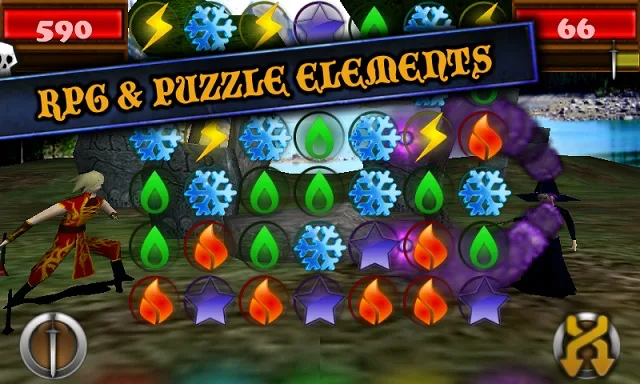
That was a great period of my early years. I learnt a lot about linear algebra, about optimization techniques, and about code structuring, mostly by doing the last one badly: the codebase was a mess.
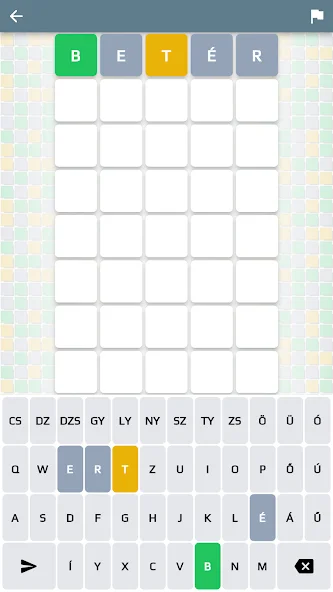
Since then I have dropped small things here and there, mostly for my own and my family’s entertainment. One of them is Szóvadász, a Hungarian version of Wordle, complete with the Hungarian digraphs like CS, GY and SZ on the keyboard. It did better than I expected in Hungary (5K+ downloads and a 4.4 rating on Google Play), and my father-in-law has hardly skipped a day of it since.
Why this one stuck
I love RPGs, and the part I love most is the machinery: stats, builds, item systems, and the math that decides whether a build actually holds up twenty levels later. That old game squeezed a surprising amount of that machinery into a small chain-matching board on a phone screen, which is most likely why it grabbed me so hard and never let go.
Gold & Skulls has been in progress for a while. The core loop is the one I remembered. Almost everything around it (the classes, the skill pool, the upgrade system, the special skulls) is the list of enhancements I spent years wishing that game had.
One chain per turn
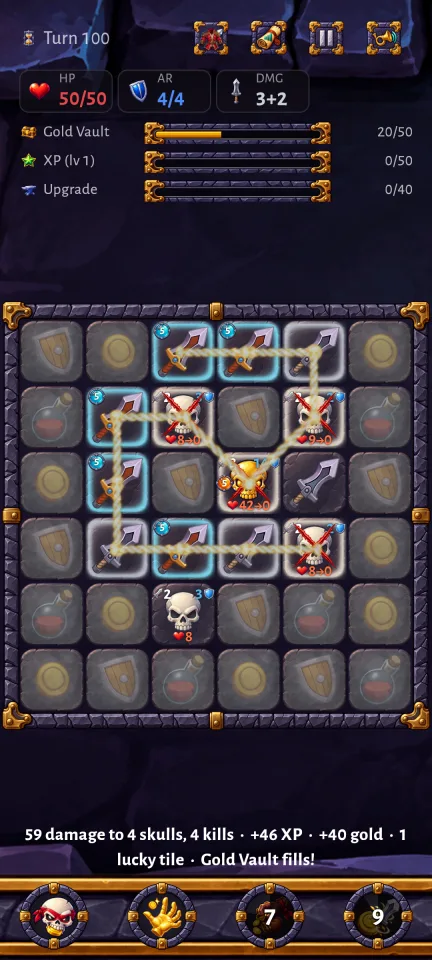
A turn is a single gesture. You drag one chain through three or more matching tiles on a 6×6 board, and each tile type does one job: coins fill your Gold Vault, potions heal, shields restore armour and fill your Upgrade meter, and swords cut down the skulls in their path. Then every skull left on the board attacks.
The rule I care about most: nothing in combat is random. Before you let go, the chain previews exactly what it will do, the damage, the kills, and the gold. So every death is a choice you made. The whole game lives in the gap between a long, greedy coin chain and clearing the skulls that are about to hurt you, and the tagline says it better than I can:
Greed fills your vault. Skulls fill your grave.
Here is what the preview looks like on a big turn:
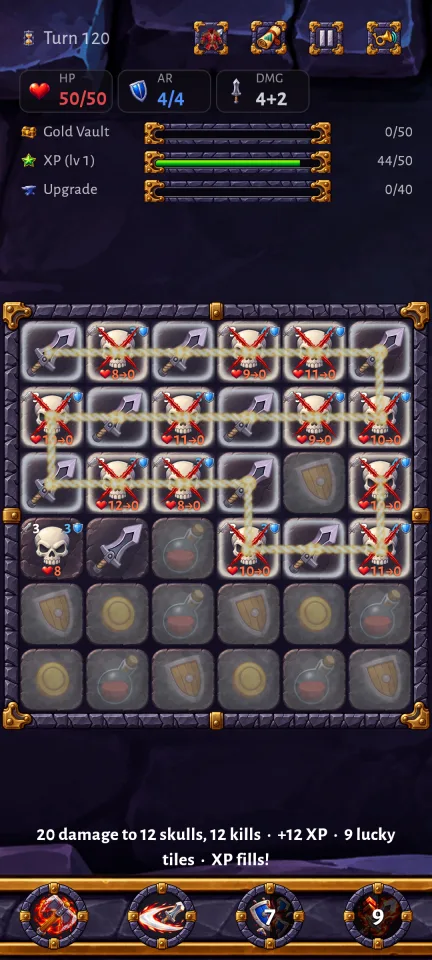
Swords are not the only thing a chain can carry. Specials drop loot, and a well-routed chain can fill two meters at once:
Building a hero, run by run
This is where the RPG nerd in me got to work. Each run grows a character through four separate systems, and they stack:
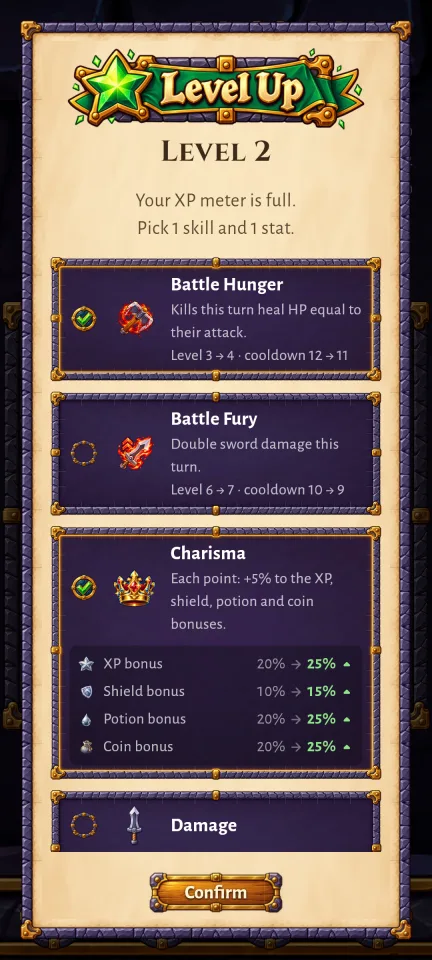
- Level Up: every time the XP meter fills, you pick a new skill and a stat.
- Item Shop: gold buys helms, armour, shields, weapons, and trinkets.
- Upgrades: life leech, spikes, swiftness, and 17 more, 20 in total, carried on the items you wear.
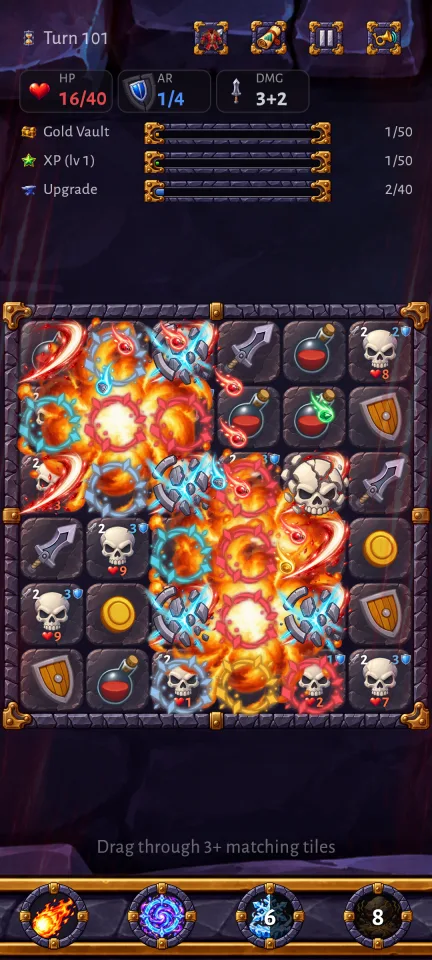
- Skills: 40 of them on cooldowns, from board-clearing magic to poison and fire.
A level-up is a small build decision, not a stat bump you click through. You pick one skill to learn or level up and one stat, and the screen shows exactly what each choice changes:
And when the skills come off cooldown at the same time, the board gets loud:
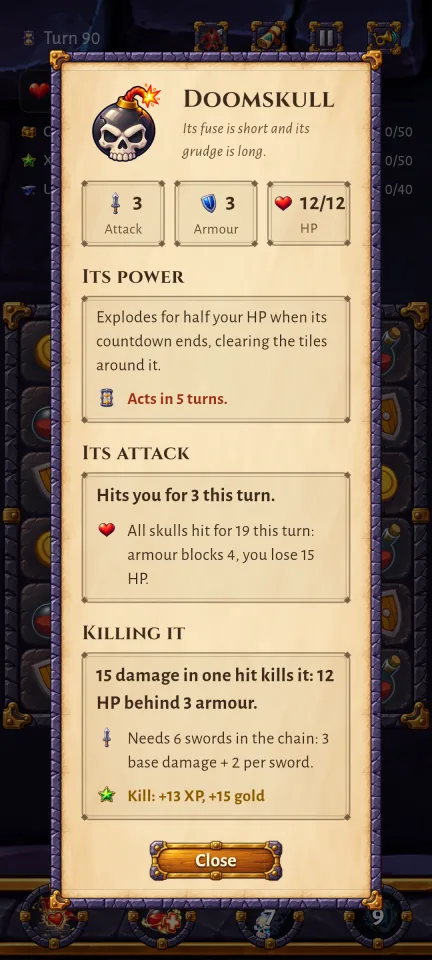
The enemies get the same depth. There are 32 special skulls, each with its own power and attack: some heal, some burn, some steal your gold. You can hold any skull to see what it does and what it takes to kill it, which keeps the no-randomness promise honest. The information is always on the board:
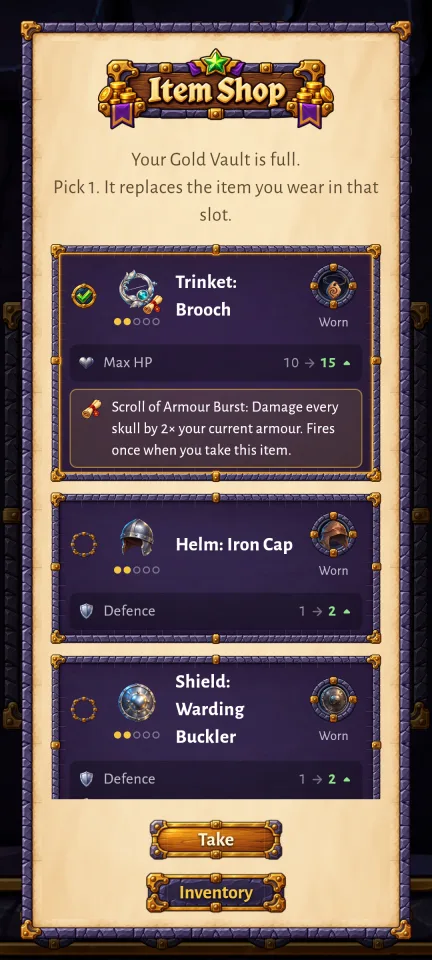
The shop opens when the vault is full, and every item replaces the one you wear in that slot:
Classes, modes, and difficulty
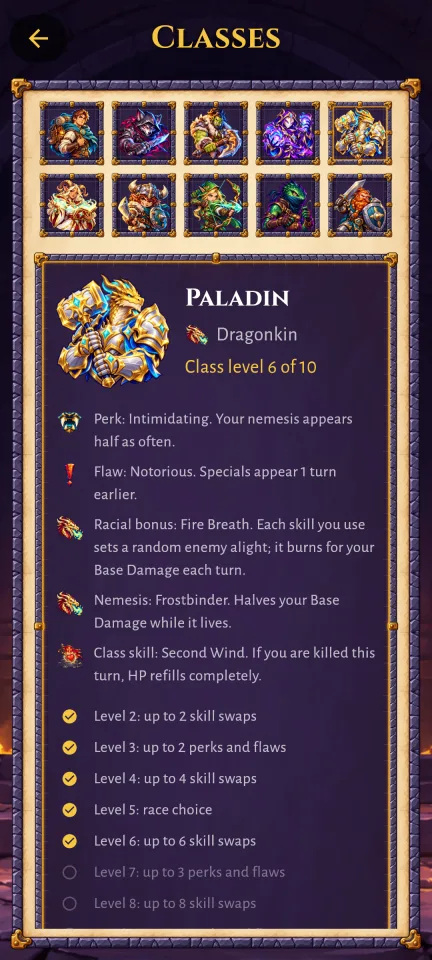
Between runs there is a longer progression. Gold & Skulls has 10 classes, and each comes with its own race, perk, flaw, racial bonus, and nemesis. Trophies from special skulls unlock new classes and raise a class’s level, up to 10, and class levels unlock skill swaps, extra perks and flaws, and the choice of race. There are 75 achievements on top.
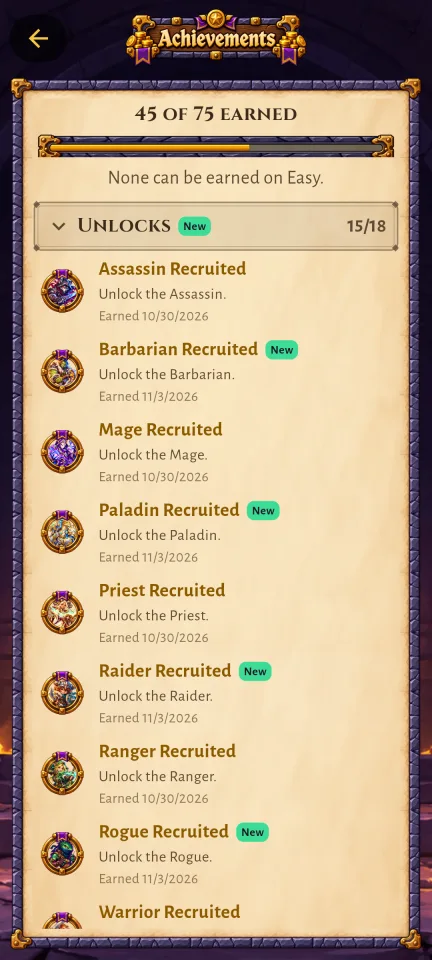
Three modes change what a run is for. Classic is survive as long as you can. Skull Sprint is 100 turns with a special skull every 10, and double XP, gold, and upgrade points. Knotmaster only scores when you cross your own path. Each mode runs on four difficulties, Easy, Normal, Hard, and Brutal, and each difficulty keeps its own high score table.
Version 1.1.0 adds the parts that make that competitive: Google Play Games online leaderboards for every mode and difficulty (friends, this week, and today), the achievements on Play Games, and The Codex, a guide to everything you meet in the dungeon, with its own Lore achievements.
Made for a phone, paid for once
Turns are short and the run is saved on every move, so closing the app mid-run costs you nothing. The tiles, skulls, and items are hand-painted, there is a full soundtrack, a gentle tutorial, and a How to play page. It ships in English, Hungarian, and Polish.
It is a premium game. One small payment, 599 HUF on Google Play, and everything is yours: no ads, no in-app purchases, no account, no tracking, and it plays fully offline. If you want to try before paying, the free demo versions are on itch.io.
A trailer from a non-video-maker
I am no video maker, so the trailer was made with Claude and Remotion, a framework that renders video from React components. That turned a skill I do not have into code, which is a problem I know how to work on:
If the embed does not load, the trailer is on YouTube.
Who it is for
If you are a developer or an engineer who likes RPGs for their mechanics, the kind of player who opens the stat screen before the map, this is the game I built for you and for me. It is a roguelike with unlockable classes and upgrades, deterministic combat you can reason about, and a loop short enough to fit between two builds. One fair warning: it is addictive. I spent fifteen years unable to forget the original, and this one has more systems.
The trade, stated plainly: a small price up front instead of a free download, in exchange for a game that never interrupts you, never asks who you are, and never sells you the next run. Gold & Skulls is on Google Play, and its own page sits at lezli01.is-a.dev/gold-and-skulls, next to everything else I build at lezli01.is-a.dev.
// comments load as you scroll here. They live in GitHub Discussions; sign in with GitHub to join in.